P-01
Exact revision execution
If an event references commit A and its branch advances to B, ForgeCI still executes A.
Mechanism
Exact SHA fetch, detached checkout, SHA verification, immutable snapshot.
Distributed CI / Go / self-hosted
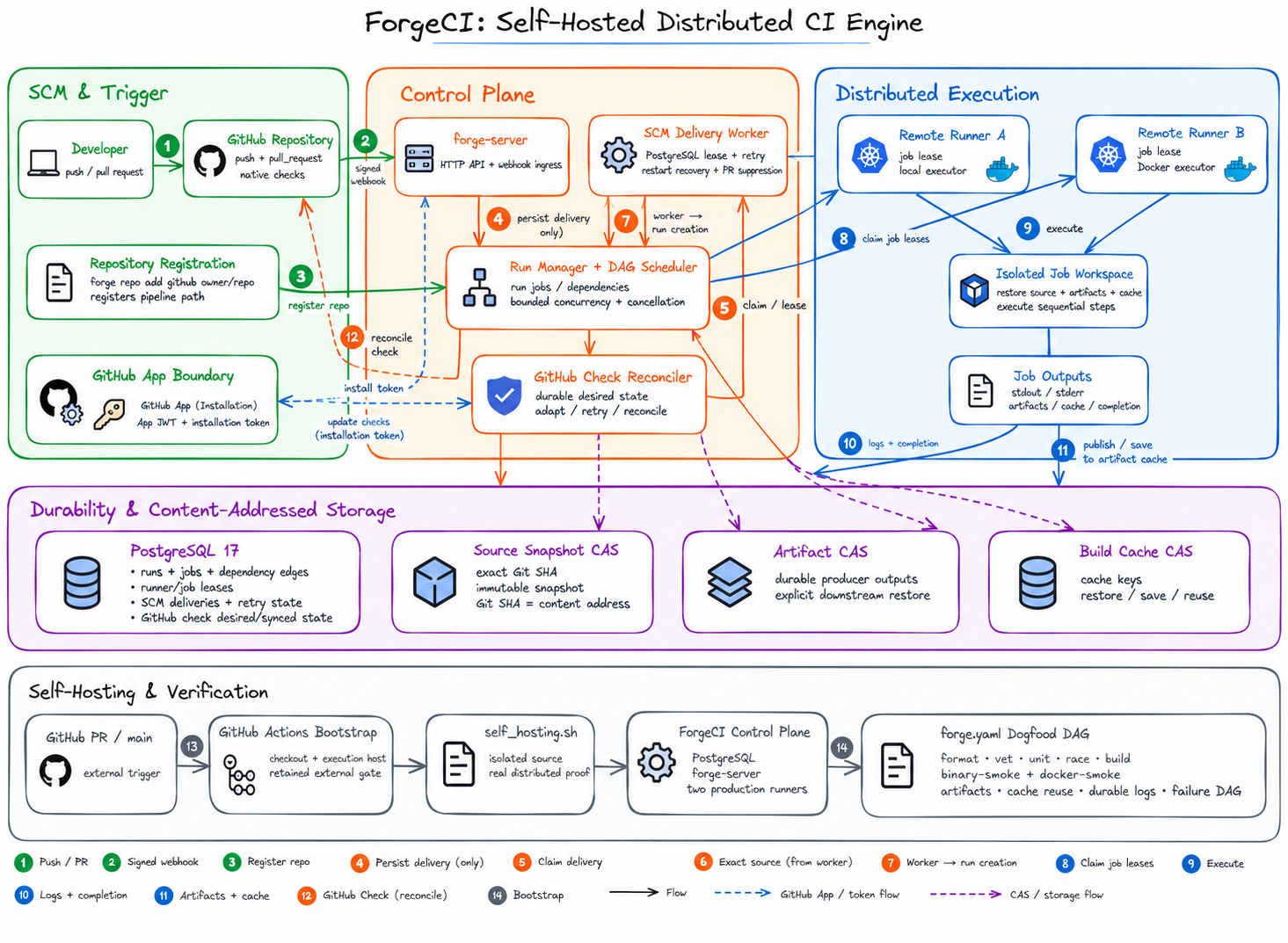
It parses repository-local DAGs, persists orchestration in PostgreSQL, leases work to remote runners, transports immutable source, and reports results back to GitHub.
DAG scheduling · remote execution · durable leases · immutable source · artifacts and cache · GitHub-native SCM
Execution plan / 01
The repository's real forge.yaml fans independent validation work across the DAG, then publishes binaries for local and Docker smoke tests.
Native SCM / 02
GitHub-specific authentication and status reporting stay at the boundary. The scheduler and runner protocol operate on provider-neutral runs, jobs, snapshots, and leases.
Correctness ledger / 03
Each claim links to executable tests, mutation checks, or integration harnesses.
If an event references commit A and its branch advances to B, ForgeCI still executes A.
Exact SHA fetch, detached checkout, SHA verification, immutable snapshot.
A stale runner cannot complete work after lease ownership has moved.
PostgreSQL lease identity, expiry, and runner-matched renewal and completion.
Retrying the same accepted delivery does not create another pipeline run.
Run, snapshot association, jobs, dependencies, and SCM trigger persist in one transaction.
A downstream job restores declared output without relying on a shared mutable workspace.
Durable content-addressed artifact storage with explicit publication and restoration.
A lost create response or restart does not orphan the desired GitHub Check state.
Persistent desired state and bounded reconciliation using a deterministic external ID.
The real project DAG executes through PostgreSQL, the server, and two remote runner processes.
Isolated committed source, two submissions, artifact retrieval, cache reuse, and failure fixture.
System blueprint / 04
Captured self-hosting run / 05
This is a static capture produced by the shared self-hosting proof driver. It is not live status. Every value below is loaded from the committed evidence summary.
Loading committed capture...
Dogfood boundary / 06
GitHub Actions supplies the outer host. ForgeCI itself captures source, parses forge.yaml, schedules the DAG, distributes jobs, stores outputs, and determines the result.
Demo run sheet / 07
One command starts the isolated control plane and leaves it available for CLI inspection. Integration testing and evidence capture use the same proof script.
Open the demo guideUse committed source and the root forge.yaml.
Two real runner processes execute independent work.
Source snapshots and explicit artifacts cross runner boundaries.
Inspect job placement, stored logs, and run result.
Compare source digests, cache access, and failure propagation.
Finish with exact revision and GitHub Check reconciliation evidence.
Design boundaries / 08